Renovation and Restoration work
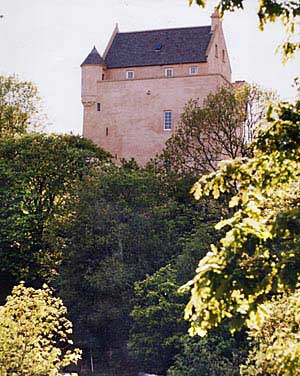
Kinlochaline Castle
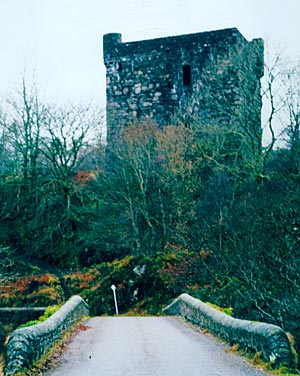
A new beginning to a castle with a varied past. Renovation work started at Kinlochaline Castle, Ardtornish, in the summer of 1997. This was an unusual and challenging build for us for many reasons, not least due to the remote location far from our island base and the considerable scale of the project.
Kinlochaline Castle,
a former 15th Century seat of the Clan MacInnes, is situated at the
head of Loch Aline, and has a lot of rich history and lore attached
to it. One of the earliest of these is the tale that one of the Clan
women paid the architect an amount of butter equal in size to the castle,
which led to the name "Ciasteal an Ime"- "castle of Butter"
to be adopted.
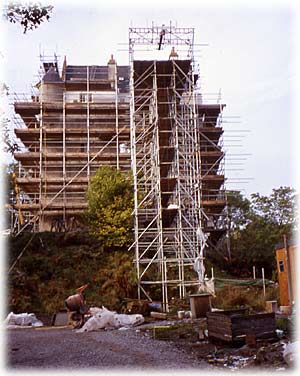
Although there had been some small scale work done on the castle to prevent it falling into complete ruin, the castle had been uninhabited since 1690 until the present owners decided to renovate the building into a family home. Realising this vision was challenging, as there were several difficulties to the build process. The original part of the castle was a large, rectangular, 3 story space with a garret rising to a corbelled parapet, however it was agreed that the best way to give the family more space, and at the same time deal with the problems surrounding reroofing the building, was in fact to construct a one and a half story bungalow on top of the existing tower. This was not the easiest job, given the height, and the ten feet thick walls of the original castle, but it was completed to a great success and the juxtaposition of the old and new builds works very well.
When undertaking the build, we worked using traditional building materials and methods wherever possible, helping to preserve the integrity of the building, although raising a few eyebrows amongst our own tradesmen!
The castle is now equipped with everything you would expect in a modern
family home, including underfloor heating. Internally there is traditional
lime plastering which is in harmony with the exterior and its traditional
lime harl finish. The Flooring used in the castle was Scottish larch,
which in a nice twist, was also grown on the Ardtornish Estate, and kiln
dried before being made into flooring boards.
This
was a tremendously challenging but exceptionally rewarding piece of work
for us to undertake, and the Raven family are now living there, and bringing
a new chapter to the history of the castle.
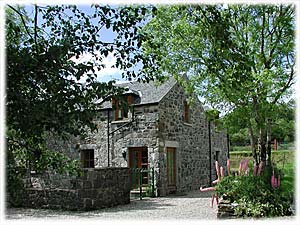
The Old Mill Lochdon, Isle of Mull
Change of use for a traditional building
The restoration of the Old Mill at Lochdon was a smaller scale renovation, but utilised many similar techniques to those which were employed at Kinlochaline Castle.
This former corn mill had been a complete ruin for many years, but the four walls of the mill were still intact. The original kiln and the mill wheels were still in the building, and it was removing these huge wheels which presented us with the biggest problems. However, once this was achieved the rest of the build went very smoothly. We wanted to include something in the renovation from the buildings' past life, and decided to use the bricks from the old kiln as the basis for the new fireplace, which has helped to create a building of immense charm and character, and one we are very proud of.
The Old Mill was transformed into a 3 bedroom house which still maintains a very traditional feel. It is currently rented out as a holiday home, which gives many visitors the chance to see the old mill in its new glory.
The
Old Mill received an Argyll and Bute District Council Planning award for
excellence
Larach Mhor, by Calgary Isle of Mull
Old Primary school becomes millennium pottery school
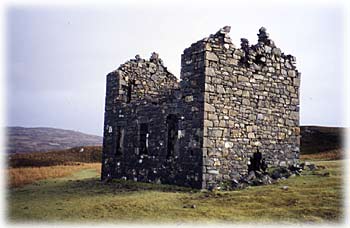
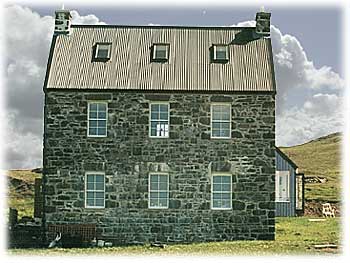
Reudle School was in use in the 1850's to 1870's but from then onwards the building lay empty, gradually being eroded by the severe winds which batter the area, until in 1997, local potter Charlotte Mellis and her husband bought the property with a view to renovating it into their home and studio. Although neglected, the old school still had its exterior shell, and many interesting features, the most quirky of which was that over the years many locals and tourists had engraved their signatures on the lime plaster of the original walls, some dating back to 1894. Charlotte was very keen to maintain this feature, and incorporated this into her pottery studio.
Traditional methods were also used in construction of Larach Mhor (as Charlotte rechristened the house).
Whilst maintaining a very traditional façade, the interior of the building is very modernist, incorporating wooden floors throughout, and has utilised alcoving in which Charlotte displays pottery from around the world, and a hammock to look out over the Treshnish Headland.
Larach
Mhor is a fine example of a build in which the traditional and modern
marry well, and now lights up the hill that it sits on in isolation.